
The Truth Behind the Press Brake Bending FAQs We Receive
“How thick can you bend?” We get this question a lot, but there isn’t a simple answer. When it comes to press brake bending, the real answer lies in the details. Material type, part width and tooling selection all play a role.
Understanding these variables upfront helps you design better parts, avoid surprises and get faster, more accurate answers. Here’s a closer look at press brake bending at Accurate CNC and the factors we use to determine bendability.
How Thick Can You Bend?
Well… it depends. Thickness alone doesn’t determine whether a part can be bent. Even as our Idaho machine shop’s sheet metal fabrication capabilities have expanded, successful press brake bending still comes down to multiple variables.
Before we can give a clear answer, we need as much information as possible about your part. Detailed drawings, material specifications and part dimensions let us evaluate bendability. Simply put: thorough quote requests lead to clear answers.
Material: The Starting Point
We always start by asking about material type because properties like ductility, brittleness and yield strength all affect how a material bends. Even at the same thickness, different materials require different amounts of force to bend.
For example, if you’re trying to bend a four-inch-wide strip that’s 0.125” thick with a 1.000” die opening, the required tonnage for bending would vary across materials:
Aluminum: 2.15 tons
Mild Steel: 2.69 tons
Stainless Steel: 3.36 tons
Not All Materials Bend the Same
Some materials are easier to bend than others.
Aluminum bends easily because it’s highly ductile and requires relatively low tonnage. Its flexibility means it is forgiving during bending, so a desired bend is often simpler to achieve.
Stainless steel is less forgiving and requires more bending force. It tends to work harden as it’s formed, which increases internal stress and can lead to cracking if the bend isn’t approached correctly.
Higher-strength steels and abrasion-resistant materials resist bending even more, often requiring additional tonnage, larger bend radii or specialized tooling.
These material behaviors influence bend radius, tooling choice and whether a bend can be completed successfully without damaging the part.
Why Part Width Matters
Next, we need to know how wide the part is. Width has a significant impact on tonnage requirements.
If we bent a 0.125” mild steel part with a 1.000” die opening, the required tonnage would increase significantly as the part gets wider:
4” wide: 2.69 tons
12” wide: 8.86 tons
48” wide: 32.23 tons
144” wide: 96.68 tons
This is why a narrow, thick part may bend easily, while a wider part of the same thickness may not.
Tooling Selection: The Final Piece of the Puzzle
Having the right tooling determines whether a part can be bent and how efficiently and cost-effectively it can be produced.
As a general rule, the die opening should be 8 to 10 times the material thickness. For example, a 0.125” thick part typically needs at least a 1.000” die opening.
Our CNC machine shop maintains a strong tooling inventory for material thicknesses under 0.250”. Beyond that, tooling becomes more specialized, harder to source and more expensive.
We work to maintain flexible tooling options to serve a wide range of customer needs. Our smaller press brake has an assortment of punches and dies, and we regularly reconfigure tooling setups to match each part’s requirements, allowing us to adapt quickly and deliver the best results.
Press Brake Bending at Accurate CNC
We currently operate two press brakes at our precision machine shop, giving us the ability to bend a wide range of part sizes.
Our Langmuir Titan 25 Press Brake features:
25 tons of bending force
3-axis capability
CNC back gauge
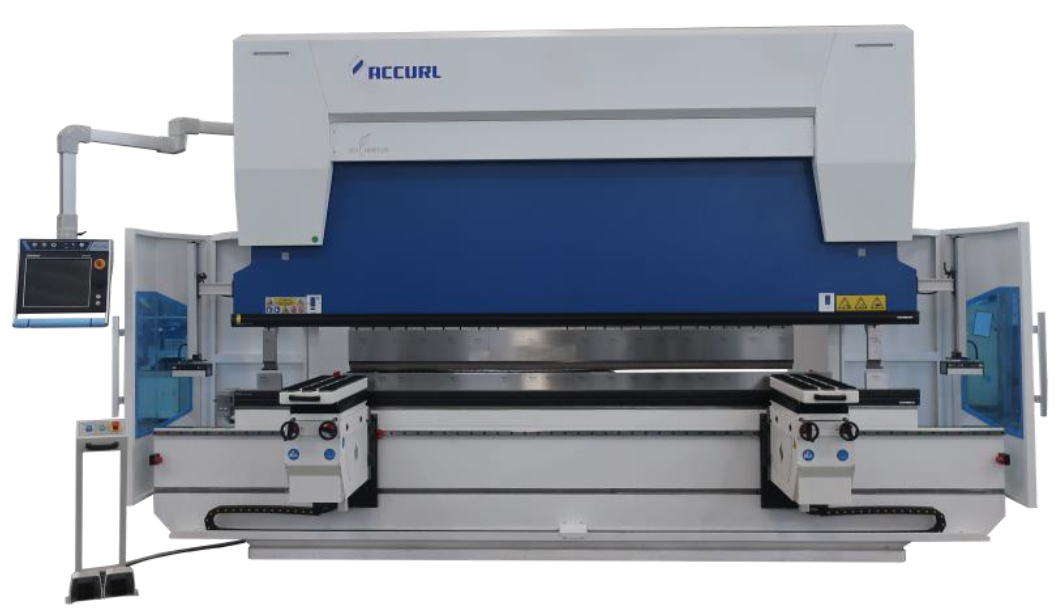
We also invested in a larger ACCURL 5-Axis CNC Press Brake GeniusPro, offering 245 tons of bending force. This expanded capacity allows us to form, bend and shape parts of varying sizes with greater efficiency, especially when working with wider parts and thicker materials.
Our Approach to Bending
As you can see, “How thick can you bend?” is a loaded question. But the more information you provide along with your part drawing, the more accurately we’ll be able to evaluate your part and determine what’s possible.
By assessing material type, part width and tooling requirements, we’ll provide realistic answers and cost-effective solutions tailored to your project.
For more on our press brake bending capabilities, reach out today!