
Everything You Need to Know About How Different Materials Behave in Press Brake Bending
As Accurate CNC continues to expand its capabilities and fabrication footprint, including larger press brake capacity, we’ve gained deeper insight into how different materials behave when bent.
Understanding these behaviors allows us to help customers make more informed design decisions and avoid costly rework, while supporting more accurate and consistent part-making.
Here’s what to consider when making material choices for bent parts to improve bend quality and overall part accuracy.
How Material Type Impacts Bending
Each material responds differently under force based on its ductility and yield strength. These properties affect tonnage requirements and bend consistency.
Mild Steel
Mild steel is generally predictable and easy to form compared to other metals. However, it can experience work hardening during bending. This means the material becomes stronger and more resistant after deformation.
Understanding these changes is important for maintaining bend accuracy, which is why Accurate CNC relies on experienced operators and proper setup procedures to deliver consistent results.
Stainless Steel
Stainless steel requires significantly more force to bend, often about 50 percent more tonnage than mild steel. Depending on features and bend length, this can add complexity to the job.
In addition, stainless steel exhibits more springback and tries to return to its original shape after bending.
Aluminum, Copper, and Brass
When softer materials like aluminum, copper, and brass are bent, they can be prone to cracking. Using a slow, controlled bending speed helps prevent tearing along the bend line.
Cracking or tearing can occur when some softer materials are bent aggressively. A more controlled bending speed, along with the right tooling and bend radius, can reduce that risk.
How Thickness Affects Bend Behavior
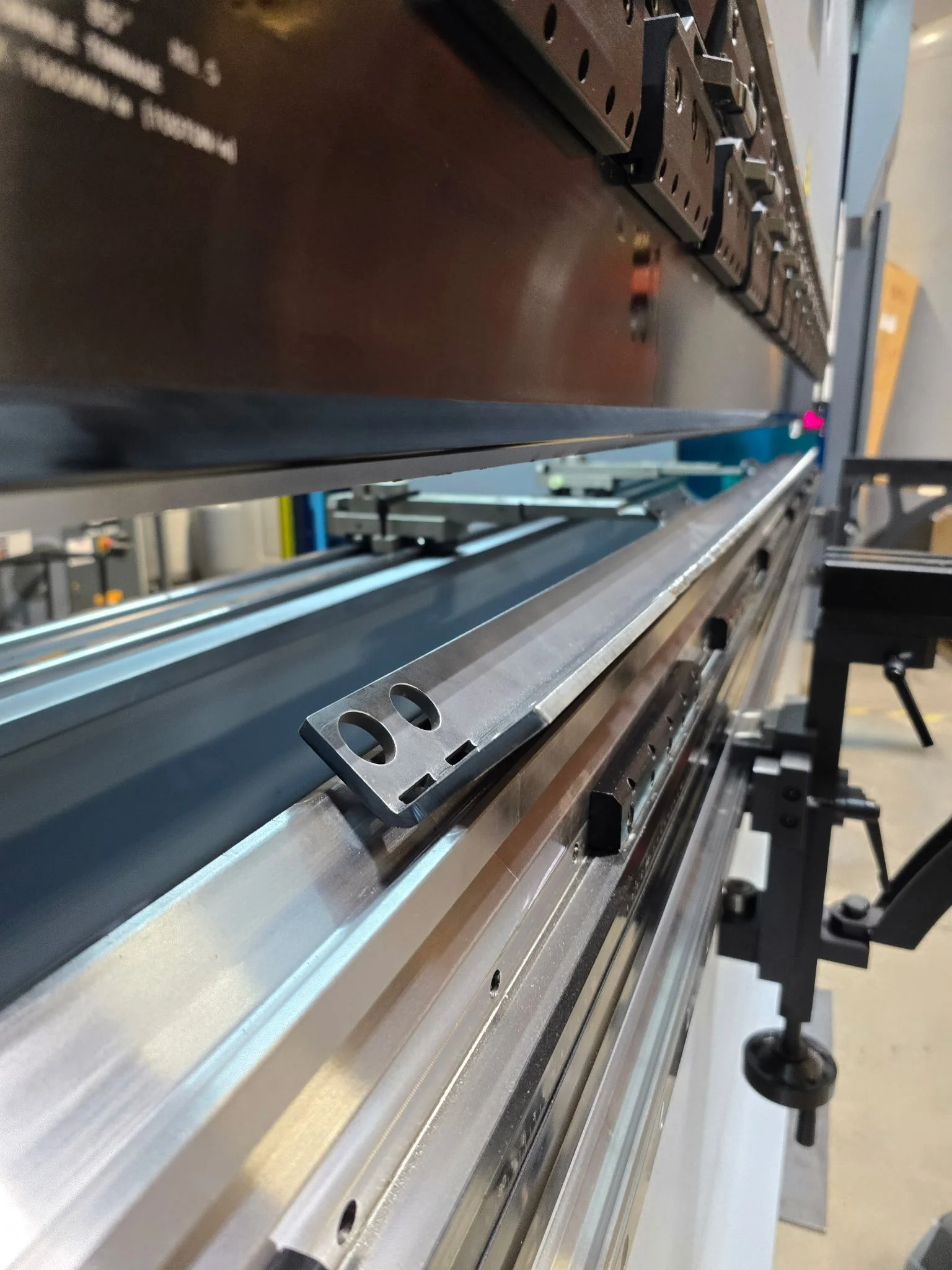
Material thickness plays a key role in how a part responds during forming.
As thickness increases:
Tonnage requirements increase significantly
Springback becomes more noticeable
Maintaining consistent bend angles across long parts becomes more challenging
However, as we’ve noted in previous articles, thickness alone doesn’t determine whether a part can be bent successfully. Multiple variables work together in the forming process.
Length, Geometry, and Forming Limits
Part length and geometry also influence how material behaves under pressure.
Our new, larger press brake enables us to bend longer parts, but as part size increases, more precise control of force distributions and tooling setup is needed to maintain accuracy.
Certain design features, such as holes placed too close to bend lines, can also impact formability and may not be achievable.
Grain Direction and Material Response
Grain direction plays an important role in bending performance.
Bending with or against the grain can influence:
Required tonnage
Risk of cracking
Overall bend consistency
This means, for some materials, parts should be organized the same way on the sheet. If they are nested and rotated, the bend quality could be affected.
Understanding K-Factor in Bend Accuracy
Because each material behaves differently during forming, K-factor is not universal. It varies depending on material type, thickness, tooling, and forming conditions.
K-factor plays a key role in flat pattern development by helping determine how the material stretches and compresses during bending. As a result, it directly affects flange length and dimensional accuracy.
For complex components like welded assemblies, accurate flat patterns are essential to ensure all features align correctly after forming.
For example, we manufacture vault doors for a customer whose frames must align precisely at every seam and welded joint. If the K-factor used in flat pattern development is not accurate for the material and process, the resulting flat pattern can be incorrect, leading to incorrect flange lengths.
At Accurate CNC, we measure the physical stretch of the material under our specific tooling so flat patterns translate to accurately formed parts. This helps critical assemblies, like vault door frames, align properly at every seam and weld the first time.
Press Brake Support from Accurate CNC
Understanding how materials behave under force leads to better outcomes from the start. The wrong material choice or overlooked design detail can lead to rework, resulting in increased costs and longer lead times.
With these tips and tricks, Accurate CNC is equipped to support your press brake bending needs with accuracy and consistency.
For press brake support and help with your next bent component, request a quote from Accurate CNC today.